BLOG
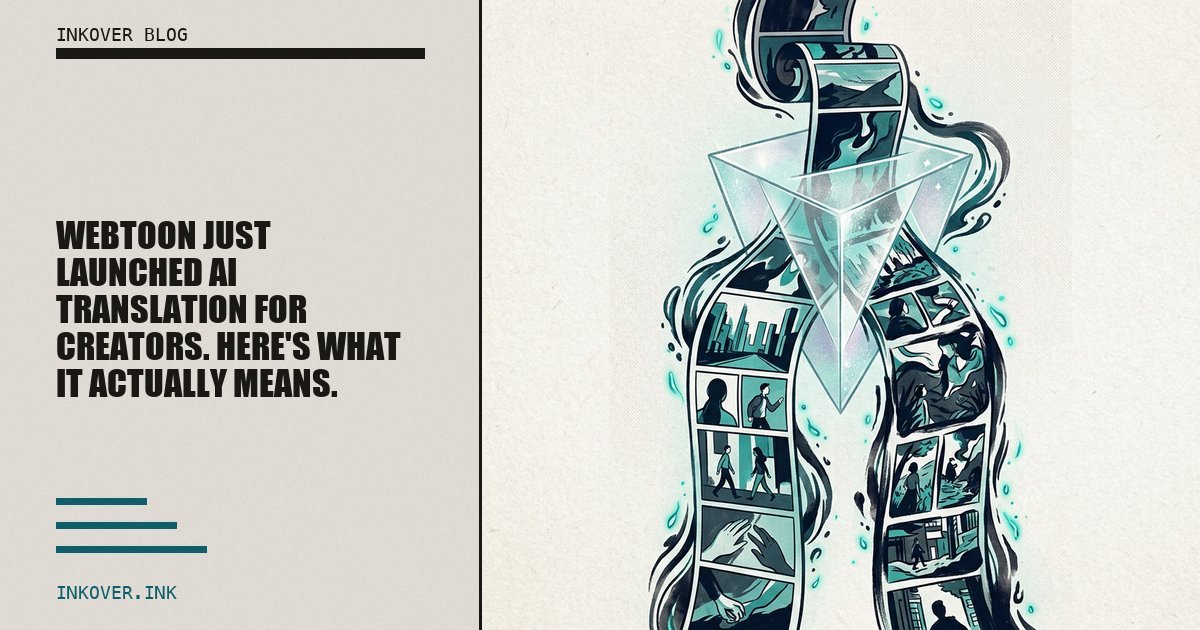
WEBTOON Just Launched AI Translation for Creators. Here's What It Actually Means.
The Announcement
In March 2026, WEBTOON announced the biggest change to its creator platform in years: a unified global CANVAS platform that merges seven regional services into one — and an AI-powered Translation Program that lets English-language creators auto-translate their comics into six additional languages (Spanish, French, Thai, Indonesian, German, and Traditional Chinese).
The program is rolling out in beta this spring, starting with invite-only access for select English CANVAS creators. It's opt-in. It translates text only — it doesn't use visual data and doesn't train on creator art. Creators can add a glossary and context notes to fine-tune translations. And alongside it, WEBTOON is redesigning its Creator Dashboard with deeper analytics and performance tools.
This is significant. Not because AI translation is new — it isn't — but because the largest webtoon platform in the world just made it a built-in feature for indie creators. That changes the landscape.
What the Program Actually Does
Let's be specific about what WEBTOON's AI translation does and doesn't do.
What it does: It takes the text from a CANVAS creator's episodes and translates it into the six supported languages. Creators can provide a glossary of character names, world-specific terms, and contextual notes to guide the translation. The translated text is then placed back into the comic.
What it doesn't do: It doesn't touch the art. It doesn't redraw text that's embedded in the image (like sound effects drawn as part of the panel). It doesn't handle the visual pipeline — inpainting, text rendering on varied backgrounds, or format adaptation. It's a text-layer translation tool, not a full manga/webtoon translation pipeline.
This distinction matters. For dialogue-heavy webtoons with clean, separated text layers, this works well. For action-heavy series where sound effects, stylized text, and visual storytelling are intertwined with the art, it covers only part of the problem.
Why WEBTOON Built This
The math behind this decision is straightforward. WEBTOON has over 800 active titles on its Korean platform alone. CANVAS — the user-generated content side — has thousands more. Human translators can cover the top-performing official series, but the vast majority of indie creators have no translation path at all.
WEBTOON's own framing is honest: this is a "tech solution to a human resources problem." They can't hire enough translators to cover every creator who wants to reach a foreign audience. AI fills the gap — imperfectly, but at a scale that human translation can't match.
The business logic is sound. More languages means more readers. More readers means more ad revenue and more tipping. Creators who were previously locked into English-only audiences can now reach Spanish, French, Thai, Indonesian, German, and Chinese readers. The platform grows. The creators grow. Everyone benefits — in theory.
The Quality Question
Here's where it gets complicated. Translation quality in comics isn't just about getting the words right. It's about tone, pacing, cultural adaptation, and visual integration.
A machine can translate "I won't forgive you" into six languages accurately. But can it tell the difference between a whispered confession and a screamed threat? Can it adapt a Korean honorific system into languages that don't have one? Can it preserve the comedic timing of a punchline that depends on word order?
For casual, dialogue-driven slice-of-life webtoons, AI translation is probably good enough. For genre fiction with complex worldbuilding terminology, emotional nuance, and cultural references, "good enough" starts to feel thin.
WEBTOON's glossary feature is a smart addition — it lets creators define terms that should be preserved or translated in specific ways. But a glossary can't solve tonal ambiguity or cultural adaptation. Those still require human judgment, or at minimum, human review.
What this signals for the rest of the ecosystem
WEBTOON building AI translation directly into its platform tells you where the floor is moving. CANVAS indies who had two real options before — translate manually (expensive, slow) or stay one-language (limiting) — get a third path that's free and fast. It won't be perfect, but it removes the barrier that kept thousands of creators out of global audiences. Top-tier official series still need human translators; what's actually shifting is the middle — series popular enough to warrant translation but not big enough for a full professional team. That's where AI competes hardest, and that's where standalone translation tools have to offer more than text translation to stay relevant. The value proposition for tooling shifts from "we translate text" to "we handle the full visual pipeline" — detection, inpainting, rendering, format adaptation. Text-only translation is being commoditized inside the platforms that already own the audience.
The Bigger Picture: Text vs. Visual Translation
WEBTOON's approach — translating text while leaving the visual layer untouched — is pragmatic but limited. It works because webtoons typically have clean text layers that are separate from the art. But it doesn't solve the harder problem: what happens when text is part of the image?
Manga translation, especially for Japanese manga with integrated sound effects, requires visual translation — the ability to detect text in the image, remove it, reconstruct the underlying art, and render new text in a way that matches the original style. This is a fundamentally harder problem than text-layer translation, and it's the problem that tools like Inkover, Scan Translator, and others are working to solve.
WEBTOON's AI program handles the first layer. Full manga and webtoon translation tools handle all the layers. As the industry evolves, the distinction between "text translation" and "visual translation" will become increasingly important.
What Comes Next
WEBTOON's beta starts with English creators translating into six languages. The company has said it will expand to additional markets later in 2026. It's reasonable to expect Korean-to-English translation to follow, given that Korean is WEBTOON's origin language and the largest source of untranslated content.
The Creator Residency Program, the redesigned dashboard, and the unified global CANVAS platform all point in the same direction: WEBTOON is building infrastructure to make its creator ecosystem globally accessible. AI translation is one piece of that infrastructure.
For the broader manga and webtoon translation industry, the message is clear: AI-assisted translation isn't a question of "if" anymore. It's a question of "how good" and "how complete." The platforms that combine accurate text translation with robust visual translation — handling the full pipeline from detection to final render — will define the next era of how the world reads comics.
Related reading:
- The $14 Billion Scroll: Why Webtoons Are Harder to Translate — the five reasons webtoons are a translation challenge
- WEBTOON's AI Avatars: What Translators Need to Know in 2026 — the Genies partnership, opt-in clauses, and what canonical chatbot voices mean for fan TLs
- Best AI Manga Translation Tools Compared (2026) — how Inkover, Scan Translator, and others compare
- Why AI Won't Replace Manga Translators — the case for human+AI collaboration