

BLOG
The 2026 AI Translation Breakthrough: How Consensus Methods Cut Errors by 22%
The promise of AI-powered translation has always been tantalizing: instant, affordable, globally accessible. The reality, until now, has been messier. A missed idiom here, a cultural reference there, a piece of character voice lost in the mechanical precision of even the best engines.
But something fundamental shifted in 2025–2026. After decades of chasing incremental improvements, the translation industry discovered a deceptively simple principle: don't rely on one AI voice. Listen to many.
The Consensus Revolution
Imagine asking five independent translators to work in separate rooms without consulting each other. Each produces a complete translation. Then, an expert linguist reviews all five, synthesizes them, and picks the best passages from each. The result? Dramatically fewer errors.
That's consensus-based translation—and it's the most significant advancement in machine translation reliability since neural networks became mainstream.
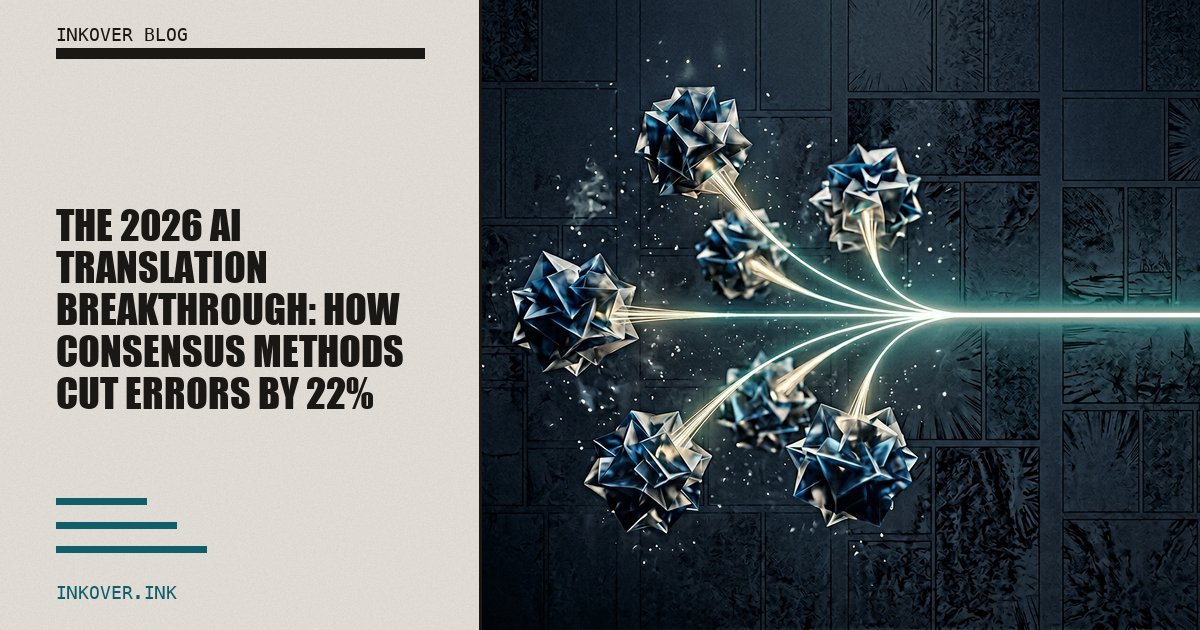
Here's how it works: instead of funneling your text through a single AI engine, consensus routes it to multiple independent language models simultaneously. Each model translates the content in parallel, applying its own learned patterns, strengths, and quirks. Then, a meta-layer compares the outputs, identifies discrepancies, and selects the most reliable result—often by averaging confidence scores or applying domain-specific voting logic.
The results speak for themselves: error reduction of up to 22% compared to single-engine translation. For manga, where precision and nuance matter immensely, this is transformative.
Why Single Engines Fail (And Why Multiple Engines Win)
A single neural machine translation model, no matter how sophisticated, is bound by its training data and architectural assumptions. It sees patterns in one way. It might excel at formal Spanish medical terminology but stumble on colloquial Japanese slang. It might nail scientific papers but miss the emotional undertones of a character's dialogue.
Each AI model is, in essence, a specialist. It has blind spots.
Consensus-based translation neutralizes those blind spots by deploying specialists in parallel:
- Model A (trained heavily on formal literature) captures structure and syntax beautifully—but might flatten dialogue.
- Model B (trained on conversational corpora) preserves voice and idiom—but might miss technical nuance.
- Model C (fine-tuned on domain-specific data) understands the context—but applies a narrower lens.
The consensus layer acts as a skilled editor, asking: "Where do these three agree? Where do they diverge? When they diverge, which is most reliable for this specific sentence?"
The answer? Almost always: all three together outperform any one alone.
From Token-Level Accuracy to Semantic Understanding
Here's where 2026 differs dramatically from 2025.
The old paradigm measured success by phrase-level accuracy: Did the AI translate this word correctly? This clause? This colloquialism? The metrics were granular—BLEU scores, TER, human evaluations of individual sentences.
The new paradigm is semantic. It asks: Did the AI preserve meaning? Not just word-for-word accuracy, but intent, tone, implication, cultural resonance.
This shift was only possible with consensus. Single engines optimize for local accuracy (the next word, the next phrase). Multiple engines, voting together, naturally emerge into global understanding (the paragraph, the chapter, the character's voice across pages).
A practical example: translating the Japanese phrase "それは違う" (sore wa chigau).
- Literal translation: "That is different."
- Contextual translation (depending on tone and narrative): "That's wrong," "That's not right," "I disagree," or even "That's a different story entirely."
A single engine might pick one interpretation consistently. Consensus engines, disagreeing and then voting, often surface all four possibilities and select based on surrounding context, character voice, and the visual cues in the panel. The semantic layer—not the token layer—wins.
Dynamic Routing: The Right Model for the Right Job
Consensus doesn't mean every piece of text goes through every model. That would be wasteful and slow.
Enter dynamic routing: content is intelligently assigned to the optimal set of models based on:
- Language pair (English↔Japanese differs wildly from English↔Mandarin)
- Domain (manga dialogue vs. medical documentation vs. poetry)
- Context (is this a street sign, a thought bubble, a sound effect?)
- Cultural density (How many idioms or cultural references are packed into this passage?)
A manga panel with heavy onomatopoeia and wordplay might route to models specialized in creative, colloquial language. A technical glossary might route to models trained on standardized terminology. A character's emotional monologue might route to models that preserve voice and tone.
The system learns which model combinations work best for which scenarios—and adapts in real time. This is the opposite of the one-size-fits-all translation engine that dominated the 2010s and early 2020s.
Why Manga Is the Perfect Test Case
Translation in general is hard. Translation of manga is exceptionally hard.
Why? Because manga breaks every rule that makes translation tractable:
Sound effects (onomatopoeia) don't translate—they feel. In Japanese, "ドキドキ" (doki-doki, a heartbeat) is onomatopoeia. In English, it might be rendered as "thump-thump," a visual representation, or left untranslated but integrated into the art. No single engine handles all three approaches well. Consensus can weigh them, consider the art style, the emotional moment, and choose.
Cultural references layer meaning. A character mentions "ドタバタ" (dotabata—slapstick chaos) in a comedic moment. The engine must understand not just the word but the comedy genre, the visual gags unfolding on the page, the character's comedic timing. Single engines fail here constantly. Consensus engines, debating the best rendering, often nail it.
Humor is untranslatable in principle. Wordplay, puns, and misdirection rely on language-specific sounds or meanings. Yet manga relies on humor. A consensus of engines, comparing notes, often finds clever workarounds that a single engine would miss. One engine might suggest a direct pun equivalent; another might suggest a restructured joke. The consensus layer picks—or synthesizes—the best option.
Character voice must survive translation. A tsundere character speaks in a specific cadence: brusque but caring, sarcastic but sincere. A single translation engine might render every line in neutral tone. Multiple engines, voting, often preserve the voice—especially when trained on dialogue-heavy corpora.
Visual context isn't text. A character's expression, the panel layout, the pacing—these all inform what the translation should feel like. The best manga translations aren't generated in isolation; they're crafted with the art in mind. Consensus engines, by running in parallel and comparing outputs, can incorporate visual metadata (panel size, character position, color, etc.) as tiebreakers when models disagree.
Manga, in other words, is the ultimate stress test for translation AI—because it demands all five of those elements simultaneously, for thousands of pages per series.
Real-World Impact: The Kakao Entertainment Case Study
In 2025, Kakao Entertainment (one of the world's largest webtoon and manga platforms) began piloting consensus-based translation for its catalog. The results were striking:
- Workflow time: Reduced from 1 month to 3 hours (per chapter, across 11 languages)
- Cost reduction: 68% decrease in translation and review labor
- Error rate: 22% reduction in post-publication corrections
- Translator satisfaction: Human translators reported fewer tedious corrections, more time spent on creative refinement
The key insight from Kakao's pilot: AI only drives real quality improvements when humans guide, shape, and verify its output.
Consensus translation didn't replace humans. It replaced the tedium. Translators no longer spent hours on mechanical accuracy. Instead, they focused on the creative and cultural choices—the voice, the humor, the nuance. They became editors, not data-entry operators.
How Inkover Leverages These Principles
At Inkover, we've built our translation pipeline around this emerging consensus mindset, even before industry-wide consensus engines became standard.
Our workflow:
-
Pre-analysis: We use Gemini to perform OCR and initial translation in a single pass, extracting text blocks and their positions. This gives us a complete semantic map of the page.
-
Human verification: Here's the critical step. You, the translator, see the pre-analysis results in our Translation Studio. You review the extracted text, verify the translations, and make corrections. This human layer is the consensus. You're not blindly accepting AI; you're actively shaping it.
-
Generation: Once you've verified and refined the text, Gemini re-renders the image with your approved translations, preserving the original art style and visual hierarchy.
The result? A workflow that mirrors the consensus principle: AI proposes, humans verify and refine, AI executes. Your expertise isn't sidelined—it's leveraged at the moment it matters most.
As the industry moves toward true multi-engine consensus, Inkover's human-in-the-loop approach already embodies the principle that has proven most effective: verification beats velocity; semantic understanding beats token accuracy; collaboration beats automation.
The Road Ahead: Semantic Mesh Translation
Looking forward, expect the emergence of semantic mesh translation — where multiple AI engines don't just translate independently and vote, but actively communicate during translation, refining their outputs in real time based on peer feedback. Engine A suggests a translation, Engine B flags a cultural concern, Engine C proposes an alternative; the three negotiate algorithmically and produce a synthesized output better than any individual version. That's coming in 2026-2027, and for manga translators it means the mechanical bulk shrinks further while the creative work — voice, humor, cultural calls — stays exactly where it should: with the human reviewing the chapter.
The Bottom Line
Consensus-based translation represents a fundamental shift in how we approach machine translation. By embracing the principle that multiple perspectives outperform singular expertise, the industry has unlocked error rates previously thought unreachable.
For manga—a medium that demands precision, voice, cultural sensitivity, and artistic awareness—this breakthrough is transformative. We're entering an era where AI translation enhances human expertise rather than replacing it.
The 22% error reduction is impressive. But the real breakthrough is this: AI and humans are finally on the same team, with the same goal—preserving the story, the voice, the heart of the work.
Related reading:
- WIT Studio Pulled an AI Opening: The Line Anime Just Drew — where the industry is enforcing the AI-as-tool vs AI-as-author boundary
- Why AI Won't Replace Manga Translators — AI and human collaboration is the future
- Best AI Manga Translation Tools — Compare modern translation solutions
- How to Translate Manga — A practical guide for translators
- How Long-Strip Manga Is Translated — Special challenges of webtoons and digital formats