BLOG
AI and Manga Copyright: What the $1.5 Billion Settlement Means for Translators
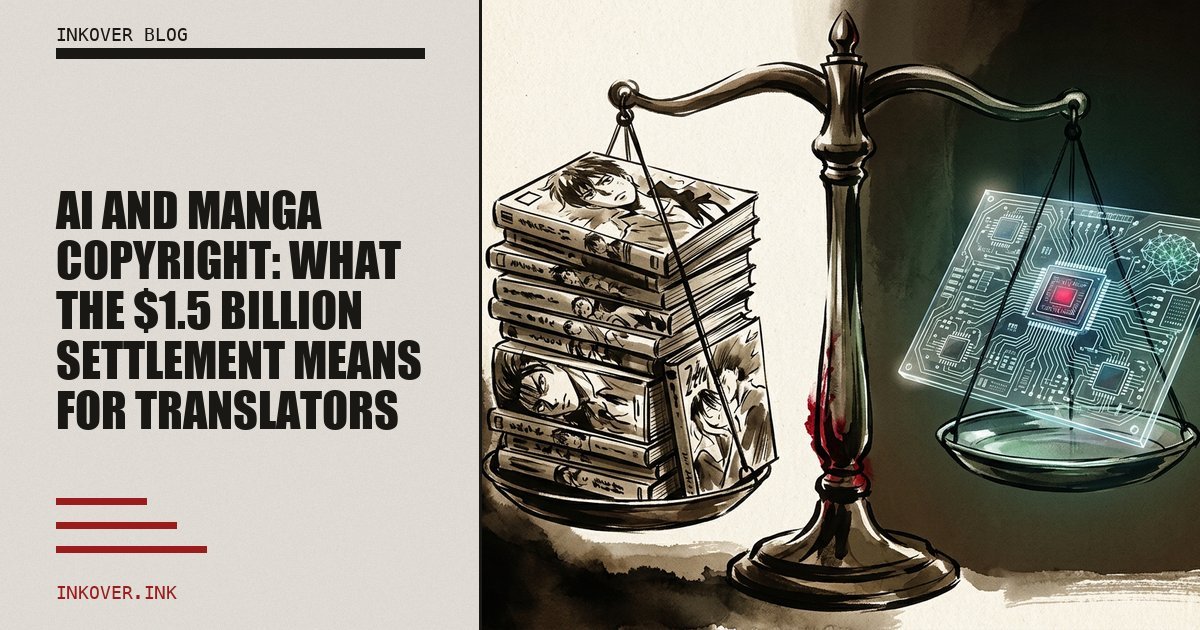
In March 2026, as copyright disputes over AI continue to reshape the entertainment industry, the landscape for manga translators has become clearer—and perhaps more optimistic than many feared. The landmark $1.5 billion Bartz v. Anthropic settlement, combined with landmark rulings from the U.S. Copyright Office and a Supreme Court decision reaffirming human authorship, has created new legal ground for translators who use AI as a tool rather than a replacement.
If you've been wondering whether AI-assisted translation workflows are legally sound, or whether your hybrid human-AI process puts you at risk, this article breaks down what's changed and why tools like Inkover that keep humans in creative control are actually more legally defensible than ever.
The $1.5 Billion Settlement: What Actually Happened
The Bartz v. Anthropic case became the largest AI copyright settlement in history when it resolved in late 2025, setting a $1.5 billion precedent. But here's what matters most: the settlement didn't ban AI training on copyrighted material entirely. Instead, it drew a crucial distinction.
The core ruling: training AI on lawfully purchased, legitimately sourced copyrighted works falls within fair use protections. The infringement claims succeeded specifically for pirated copies—works acquired through unauthorized channels, circumventing payment systems, or stripped of DRM protections.
This distinction is enormous. It means the question isn't "Can AI learn from copyrighted works?" but rather "Under what circumstances?" The settlement essentially codified that source matters. Publishers and authors who want to opt out can do so, but the act of training on legitimately purchased books is protected.
For manga translators, this has an immediate implication: if you're using AI trained on licensed manga or publicly available source material, you're on firmer legal ground than if you were training on pirated scans. More importantly, it establishes that AI tools themselves aren't inherently copyright violations—context is.
The Copyright Office and Human Authorship: AI Can't Own, But Humans Can
In January 2025, the U.S. Copyright Office released its comprehensive guidance on AI and copyright. The headline: AI-generated outputs without meaningful human creative input are not copyrightable.
This might sound like bad news for AI enthusiasts, but it's actually protective for human creators. What the Copyright Office established is that copyright requires human authorship. An AI system spitting out a chapter translation on its own? Not protected. A translator using AI for assistance, reviewing it, refining dialogue, adjusting cultural nuances, and making creative decisions? That's protected, because the human made the creative choices.
On March 2, 2026, the Supreme Court denied certiorari on cases challenging this rule, effectively upholding the Copyright Office's human authorship requirement. This isn't a temporary ruling—it's now settled law. Copyright belongs to the human who made creative decisions, not to the AI tool.
For manga translators, this creates a paradox that's actually in your favor: the more you use AI as a tool while maintaining human creative control, the more protected your work becomes. Every editorial choice you make—every decision to adjust phrasing, check cultural context, review the AI's work, and sign off on the final translation—makes the work legally yours.
The Music Settlement Pattern: Licensing, Not Bans
While the manga and publishing worlds have been navigating copyright uncertainty, the music industry has already begun writing the script. Both UMG (Universal Music Group) v. Udio and Warner v. Suno settled with licensing agreements rather than bans on AI training.
These weren't victories against AI—they were agreements on compensation and control. UMG and Warner didn't demand that Udio and Suno stop using music for training. Instead, they negotiated licensing deals that ensure rights holders get paid and have some say in how their work is used.
The pattern is clear: the music industry's move toward licensing suggests that the manga and publishing industries will likely follow. Rather than wholesale prohibition, we're seeing the emergence of a framework: opt-in licensing, fair compensation, and clear contractual agreements.
For translators working with AI, this suggests that as the publishing industry matures in its relationship with AI, we're likely to see similar licensing frameworks. Rights holders will be compensated, and tools that use copyrighted material will do so transparently and with consent mechanisms in place.
The Copyright Office's Case-by-Case Reality: Fair Use Is Nuanced
In May 2025, the Copyright Office released updated guidance that added important nuance: "Some uses of copyrighted works for AI training qualify as fair use; some do not."
This isn't a bug—it's a feature. Fair use has always been a case-by-case analysis, and the Copyright Office acknowledged that AI training doesn't change that fundamental legal principle. Instead, each case depends on:
- The nature and purpose of use — Is the AI transforming the work? (Translation, for example, is inherently transformative)
- The amount of material used — Are you using entire works or samples?
- The market effect — Does the use substitute for the original or complement it?
- The nature of the copyrighted work — Factual works have broader fair use; creative works are more restricted
Manga translation is inherently transformative. You're taking source material in one language and creating a new work in another language, for a different audience, in a different cultural context. That transformation—the core of translation—is the textbook example of fair use in copyright law.
When you add human review, cultural adaptation, and creative editorial decisions on top of AI assistance, you're adding another layer of transformation. The human translator has always been the one doing the creative work in translation. AI assistance doesn't change that—it just makes the translator more efficient.
Fan Translation and the Gray Zone
Let's be direct: fan translation of manga occupies a legal gray area, and it always has. Fan translators typically don't have permission from the copyright holder, and their work can substitute for official translations. That hasn't changed with AI.
However, what has changed is that fan translators using AI assistance may actually be on slightly firmer ground than those working manually. Here's why: if the AI was trained on licensed material (which most major AI translation tools are), the training itself is legally clearer. And if the translator is making meaningful human creative decisions—adapting language, checking context, ensuring quality—that human contribution is legally protected under the new Copyright Office rules.
This doesn't mean fan translation becomes legal, but it does mean that using AI as a tool within fan translation work is no worse legally than doing it manually, and potentially better if the AI was trained responsibly.
The bigger shift? As official licensed translations become faster and cheaper (thanks to AI-assisted workflows), fan translation's functional role diminishes. Publishers can now hire translators to produce official versions faster and more affordably. The market may solve the problem that law cannot.
Why hybrid human-AI workflows hold up
Pulling these threads together: a workflow where AI does extraction and draft translation while a human reviews every block, refines wording, and signs off lines up with all three legal anchors at once. The AI training is on the right side of the Bartz line if the model was trained on legitimately licensed material. The human-authorship requirement is satisfied because every editorial choice — cultural adaptation, idiom resolution, tone — is a creative human decision. And translation is itself a textbook fair-use transformation, which only strengthens with each layer of human judgment on top of the AI draft.
The contrast cases are clear. Fully automated translation with no review produces output that's not copyrightable under current US Copyright Office guidance and potentially infringing if the training data was sourced badly. Fan translation without AI sits in the same legal gray area it always has. A hybrid workflow — human-authored work that happens to use AI tools — is clearly copyrightable, clearly defensible, and (separately from the law) produces better translations because cultural context, wordplay, and judgment calls are still where machines fall short. Inkover is built on that workflow for both reasons: it's the legally stronger position and it's the one that produces a better chapter.
The bottom line going into the rest of 2026 hasn't changed: copyright protects human creativity, AI is a tool, and tools that keep humans in creative control of the output are protected work. Expect publishers to move toward opt-in licensing (the music settlement pattern) rather than blanket prohibition, and expect "official" AI-assisted translation to keep narrowing the role fan translation has historically played.
Note: This article is informational, not legal advice. Copyright law is complex and fact-specific — for specific situations, consult an attorney in your jurisdiction.
Related reading:
- Why AI Won't Replace Manga Translators — The case for human-AI collaboration
- The Best AI Manga Translation Tools in 2026 — A guide to available platforms
- Webtoon's AI Translation Move: What It Means — Major publishers embracing AI workflows
- How to Translate Manga: A Complete Guide — Fundamentals for translators of all levels
- Yandex Books Manga Push: 168-FZ Compliance for Scanlators — What new Russian platform regulations mean for scanlators