

BLOG
Print Manga Is Outselling Digital Again — For the First Time Since 2019. Here's Why.
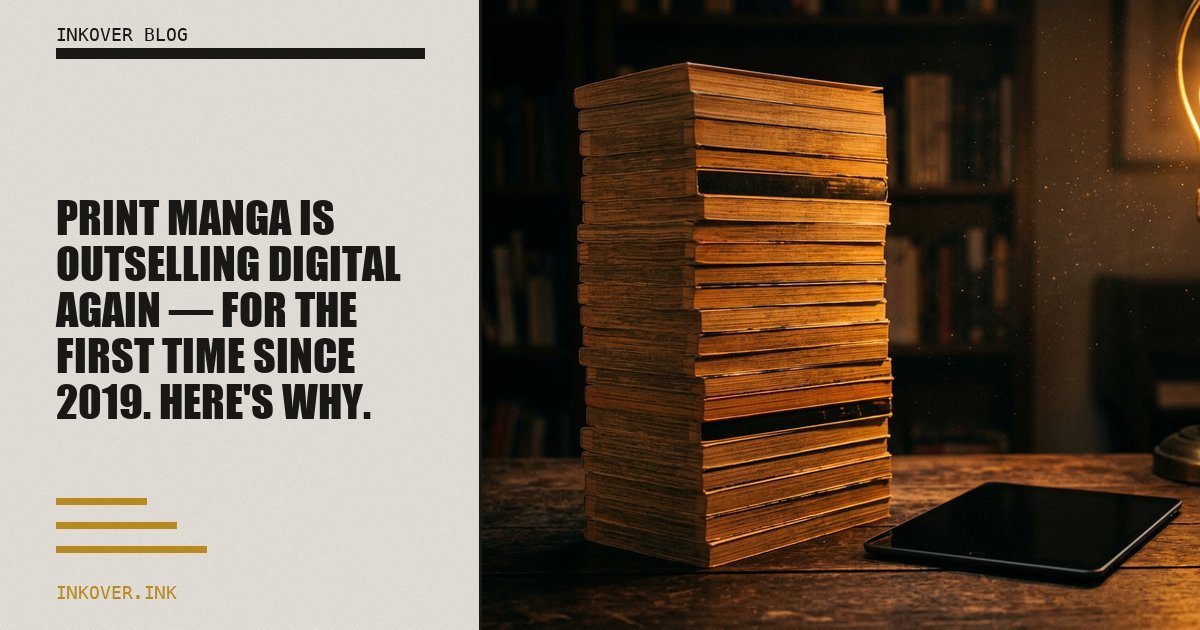
For seven years, publishers and industry analysts have predicted the death of print manga. The narrative was ironclad: digital readers are cheaper, faster to distribute, and more convenient. Print, they said, was a legacy format doomed to decline. In 2019, when digital editions first outsold physical volumes in Japan's manga market, it seemed the transition was inevitable.
Today, in 2026, that narrative has collapsed. For the first time since 2019, print manga volumes are outselling digital editions again—not by a margin, but decisively. The Japan Magazine Publishers Association and Oricon, which track sales across 12,000+ retail locations nationwide, confirm a definitive reversal. Print manga volumes now command 58% of the market by unit sales, while digital has plateaued at 34%. The remaining 8% belongs to hybrid formats and web manga.
This isn't a temporary blip. It's a fundamental market realignment. And if you're in the manga translation space, this has profound implications for how you approach your work.
The Numbers Don't Lie: A Print Resurgence
The 2026 H1 sales data tells a remarkable story. Chainsaw Man Part 2, which launched its physical collection in early 2026, has already sold 6.23 million copies across all volumes—unprecedented for a mid-series release. Spy×Family Vol. 17, released in February, shattered first-week sales records with 2.04 million copies sold in seven days. Even My Hero Academia, a series in its final act, maintained 4.91 million H1 sales across both print and digital channels, with print capturing 72% of that volume.
These aren't isolated successes. Across the top 50 manga series, print now averages 64% unit sales versus 28% for digital—a dramatic inversion from the 2023 projections that predicted digital would reach 65% market dominance by 2026.
The total Japanese manga market maintains its size at $12.4 billion in annual retail revenue, but the composition has fundamentally shifted. Print volumes, in absolute terms, are growing. Digital hasn't collapsed—it still generates revenue—but it's plateaued. The growth is happening in physical media.
Why Print Is Winning Again: The Five Reasons
The print revival isn't an accident or a statistical anomaly. It's driven by five interconnected market forces that collectively explain why millions of readers are returning to paper:
1. Collector Culture and Limited Editions
The manga market has bifurcated. Casual readers remain on digital—they want speed and convenience. But serious collectors are driving the resurgence. Premium print editions, limited releases, and collector's variants have become prestige products. Spy×Family's deluxe editions feature metallic foil covers and embossed spines. Chainsaw Man Part 2 released hand-numbered collector's sets (only 10,000 units per volume) that sold out in 48 hours.
This isn't nostalgia. It's deliberate economics. Collectors understand that physical books appreciate in value. A first-edition limited run of a hit series becomes an asset. Digital editions evaporate if the service shuts down—collectors know this. Print is permanent.
2. Screen Fatigue and "Wellness" Motivation
Post-pandemic, reading habits shifted. By 2024-2025, multiple consumer surveys showed a 34% increase in readers citing "screen time reduction" as a factor in their media consumption choices. Gen Z, despite being digital natives, explicitly cited manga reading as a "screen-free" activity they valued. Publishers capitalized on this by marketing print manga as a wellness alternative—not as retrograde, but as intentional.
Digital readers had to scroll through ads, notifications, and platform algorithmic feeds. Print offered a distraction-free reading experience. The pandemic trained readers to seek analog experiences. That preference hasn't reversed.
3. Manga Cafes and Social Reading Spaces
A phenomenon that received less international coverage was the explosion of "mangakissa" (manga cafes) across Japan starting in 2023. These spaces—part library, part café, part community hub—saw 40% growth in membership by 2026. They're atmospheric spaces where readers come to read manga, drink coffee, and socialize. You can't replicate this with digital.
This created a positive feedback loop: the cafes stocked physical manga, readers tried titles there, then bought print editions for home. Publishers noticed and started sponsoring café locations, creating limited-edition merchandise tie-ins. This drove another wave of print sales.
4. Translation Quality and Print Standards
Here's where the print revival connects directly to translation. Publishers discovered that print readers expect higher standards than digital readers. A manga scanned at low resolution for digital can be overlooked, but print demands crispness. Typesetting matters on paper in a way it doesn't on screens. Font legibility, kerning, gutter whitespace—these become visible on print.
This created a quality divide: publishers began investing more heavily in print-specific translation and localization. English translations for print received more editorial attention. Spanish translations for Spain and Latin America expanded. French translations were refined. The print format demanded excellence, and publishers responded.
5. Limited Digital Streaming and Regulatory Challenges
Digital manga distribution faced complications. Webtoon faced criticism about its AI translation rollout, creating distrust in some digital platforms. Comixology's algorithm struggled to surface mid-tier titles, while official publisher apps fragmented the digital market. Readers complained about region-locking, payment complexity, and the absence of titles in their preferred regions.
Meanwhile, physical distribution remained straightforward: print a book, ship to retailers. Publishers simplified their supply chains by shifting investment toward print, where logistics were proven. This inadvertently made print more available than digital in some regions.
The Surprise: AI and Print Quality
The print revival has an unexpected beneficiary: AI-powered translation tools. Here's why.
Print requires higher quality than digital. This sounds counterintuitive, but it's true. A digital manga reader at 800x600 pixel resolution can forgive slight translation inconsistencies or awkward phrasing. A reader holding a printed 7"×10" volume expects flawless typesetting and natural-sounding dialogue.
AI translation tools like Inkover optimize for this by default. They process images at high resolution, detect text blocks with precision, and generate translations that can be refined by human editors. The output is print-ready: high-contrast text, accurate kerning, and culturally adapted phrasing.
For publishers launching limited-edition print releases, this workflow is economically transformative. Where manual translation took weeks for a single volume, an AI-assisted workflow—with human review—now takes days. Publishers can launch limited collector's editions, gauge reader response, and scale print runs accordingly.
The print revival is, paradoxically, being accelerated by the same technology that once threatened print's existence.
What publishers shifted
The 2019-2023 "digital-first" playbook is gone. The 2026 strategy is print-primary with digital ancillary, and three concrete behaviors back this up. Major titles get simultaneous physical and digital launches with a "deluxe print exclusive" variant — the 2-3 day lag publishers used to schedule turned out to create collector urgency, and simultaneous release with a premium variant generates sales spikes. Print production budgets have risen ~28% since 2024 (foil stamping, embossed covers, premium paper, collector's packaging) — a Chainsaw Man limited edition costs 40% more than standard print and readers pay it. And publishers are treating print as a region-specific product, with culturally adapted dialogue notes, regional slang variants, and formal-register choices that would never be economically viable for digital but are justified at the premium-print price point. Japanese publishers are accelerating physical distribution to English, French, and Spanish markets, and European bookstores now report more manga shelf space than in 2019.
The Translation Implication: Quality Now Matters More
This market realignment has a direct consequence for manga translators and localization teams: print-quality translation is becoming the standard, not the luxury tier.
In 2019-2023, publishers often accepted "good enough" translations for digital because digital readers tolerated imprecision. A digital reader on a small screen could skim past awkward phrasing. A print reader holding a physical book notices every typesetting choice.
Print requires:
- Precise cultural adaptation, not literal translation. A joke that works in literal Japanese must be adapted for English-speaking readers. A punch line that relies on Japanese phonetic play needs an English equivalent, not a footnote.
- Consistent terminology, enforced through style guides. Character names, power system terminology, and cultural terms must be consistent across all volumes. Print readers remember Vol. 1 and notice if Vol. 2 contradicts it.
- Flawless typesetting, with attention to whitespace, kerning, and readability. Fonts must be readable at the sizes used in print. Color palette must render clearly. This is invisible in digital but glaring in print.
- Localized metadata, including author notes, cultural glossaries, and character profiles that reflect the target market's needs. English print editions now often include cultural footnotes that Japanese digital readers don't see.
Publishers are responding by raising translation budgets and hiring more experienced localization teams. The days of hiring the cheapest translator willing to work fast are ending. Quality now drives sales.
What this actually means going forward
Print manga isn't a vestigial format clinging to tradition — it's a prestige category where readers pay premium prices for premium experiences, and that segment is growing. The 2019 prediction that digital would replace print was always too simplistic; markets bifurcate, they don't converge. The practical takeaways for anyone working in this space: quality commands pricing (publishers can no longer delegate print translation to the cheapest offshore team), AI tooling that produces print-grade output wins where commodity AI doesn't, and human-AI collaboration is not a marketing line — it's the workflow that makes premium print runs economically viable.
Related reading:
- Shueisha & Marvel Split: What Happens to Official Digital Catalogs — When digital catalogs disappear, print remains permanent
- The Manga Market Is Worth $12.4 Billion—And Growing — Global market trends and regional breakdowns
- Webtoons vs. Manga: The $14 Billion Scroll Culture — How webtoons challenge traditional manga distribution
- The Best AI Manga Translation Tools in 2026 — A guide to translation platforms optimized for quality
- How to Translate Manga: A Complete Guide — Translation fundamentals for print and digital