

BLOG
Translating Premium Artbooks: Kodansha USA's New CLAMP License
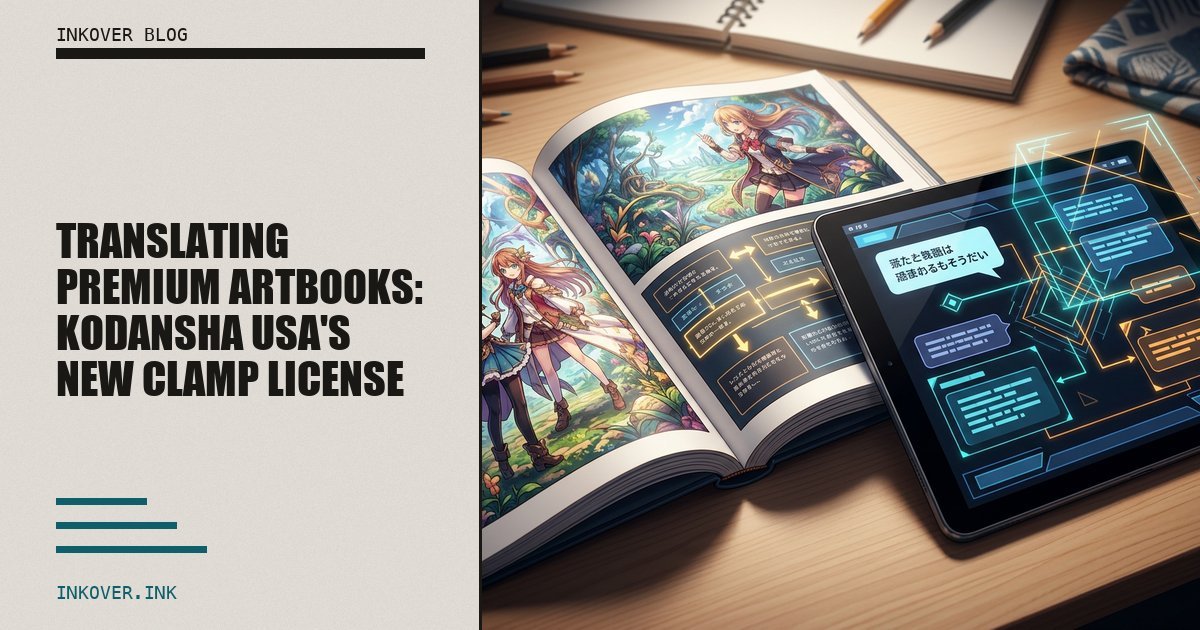
Kodansha USA has officially announced the English license for the CLAMP Official Artbook COLOR GOLD 1989–2024, slated for a Spring 2027 release. Revealed at Anime Expo 2026, this deluxe cloth-wrapped edition brings over 250 pages of legendary full-color illustrations to Western fans. But for publishers and independent translation teams alike, massive unstructured artbooks present one of the most brutal technical challenges in localization: preserving the art while translating the text.
The Artbook Problem
Unlike standard manga, where text is neatly contained in clearly defined speech bubbles on white backgrounds, artbooks are structural nightmares for localization pipelines. Text is often painted directly over complex, multi-colored illustrations. Author notes, character names, and commentary snake around character designs or fade into painted, textured backgrounds.
When a standard Optical Character Recognition (OCR) pipeline hits an artbook page, it fails spectacularly. It either misses the stylized, handwritten text entirely, or it attempts to extract the text by aggressively masking the area. This leaves hideous white boxes that destroy the original artwork beneath. For a premium product like the CLAMP GOLD artbook, which compiles legendary work spanning from Cardcaptor Sakura to X, destroying the art to read the text defeats the entire purpose of the book.
Solving the Unstructured Canvas
This is where the technical gap between amateur scanlation tools and professional-grade localization software becomes glaringly obvious. To translate a high-end artbook without redrawing every single page by hand in Photoshop, teams need advanced spatial text detection that understands context.
This is the exact localization challenge that Inkover's homography D2 text detection was built to solve. Instead of blindly reading high-contrast pixels like legacy OCR, homography D2 maps the spatial relationships of the text across an unstructured canvas. It understands the angle, curve, and distortion of the typography relative to the complex artwork behind it.
Preservation over Replacement
When the D2 model identifies a string of Japanese text woven into a dense CLAMP illustration, it doesn't just rip it out. It isolates the text layer from the underlying illustration, allowing translators to swap the text while preserving the integrity of the original brushstrokes, gradients, and colors beneath.
As publishers like Kodansha bring more premium, high-fidelity artbooks to the global market, the standard for translation software is shifting. It's no longer just about translating the words accurately; it's about having the technical infrastructure to preserve the original visual masterpiece intact. Teams equipped with advanced homography detection can now take on these premium localization projects in a fraction of the time, without compromising the art that fans are paying to see.