

BLOG
Cyberpunk: Edgerunners 2 & The Challenge of Holographic UI Translation
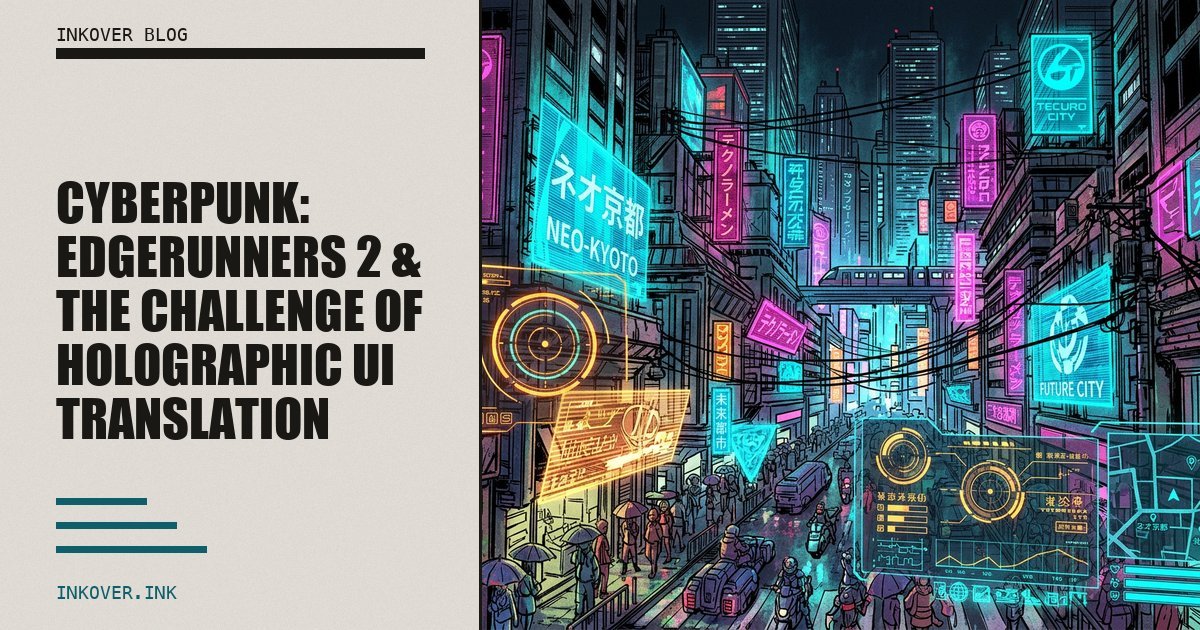
On June 30, 2026, Netflix and Studio Trigger officially revealed Cyberpunk: Edgerunners 2, confirming a Fall 2026 debut. The new standalone season introduces a fresh cast and promises a return to Night City's visually overwhelming, neon-drenched aesthetic, bringing intense new challenges for localization teams.
What actually happened
The official announcement from Studio Trigger and CD Projekt Red detailed several key elements for the upcoming season:
- The structure: It will be a standalone 10-episode story directed by Kai Ikarashi, set within the Cyberpunk 2077 universe.
- The cast: A completely new roster of characters was revealed. Talia Yang will be voiced by Akari Kitō (JP) and Kimoy Lee (EN). Other key cast members include Kōki Uchiyama and Nazeeh Tarsha as "D", Momoka Terasawa and Valeria Rodriguez as Roman Carax, and Kentarō Tone and Clancy Brown as Weak Kingsley.
- The sound: The teaser featured the track "You Can't Run From Me" by Rico Nasty, confirming the return of the franchise's signature aggressive auditory style.
The holographic UI translation challenge
Night City isn't just a background setting; it is a hyper-dense, information-overloaded environment. Translating the Cyberpunk universe—whether adapting manga spin-offs, storyboards, or on-screen text—means constantly dealing with diegetic holographic text, skewed neon signs, and floating augmented reality (AR) interfaces.
Traditional translation pipelines struggle significantly when text isn't flat on a page. When UI elements are projected at severe angles or mapped onto curved surfaces in the artwork, standard horizontal replacement layers look unnaturally flat. Slapping a perfectly level line of translated text over a holoscreen tilted at a 45-degree angle immediately breaks the reader's immersion.
What changes for tools
This specific visual density is where advanced rendering pipelines become essential. To seamlessly replace angled holographic text without it looking "pasted on," systems like Inkover rely on homography D2 alignment as a mandatory post-processing step.
When AI models redraw text, they occasionally introduce geometric distortions or fail to match the extreme perspective of the original plate. Homography correction mathematically aligns the newly generated translated text to perfectly match the perspective, tilt, and distortion of the original holographic sign. For teams localizing dense cyberpunk aesthetics, this spatial awareness isn't a luxury—it's the baseline requirement for keeping the world believable.